
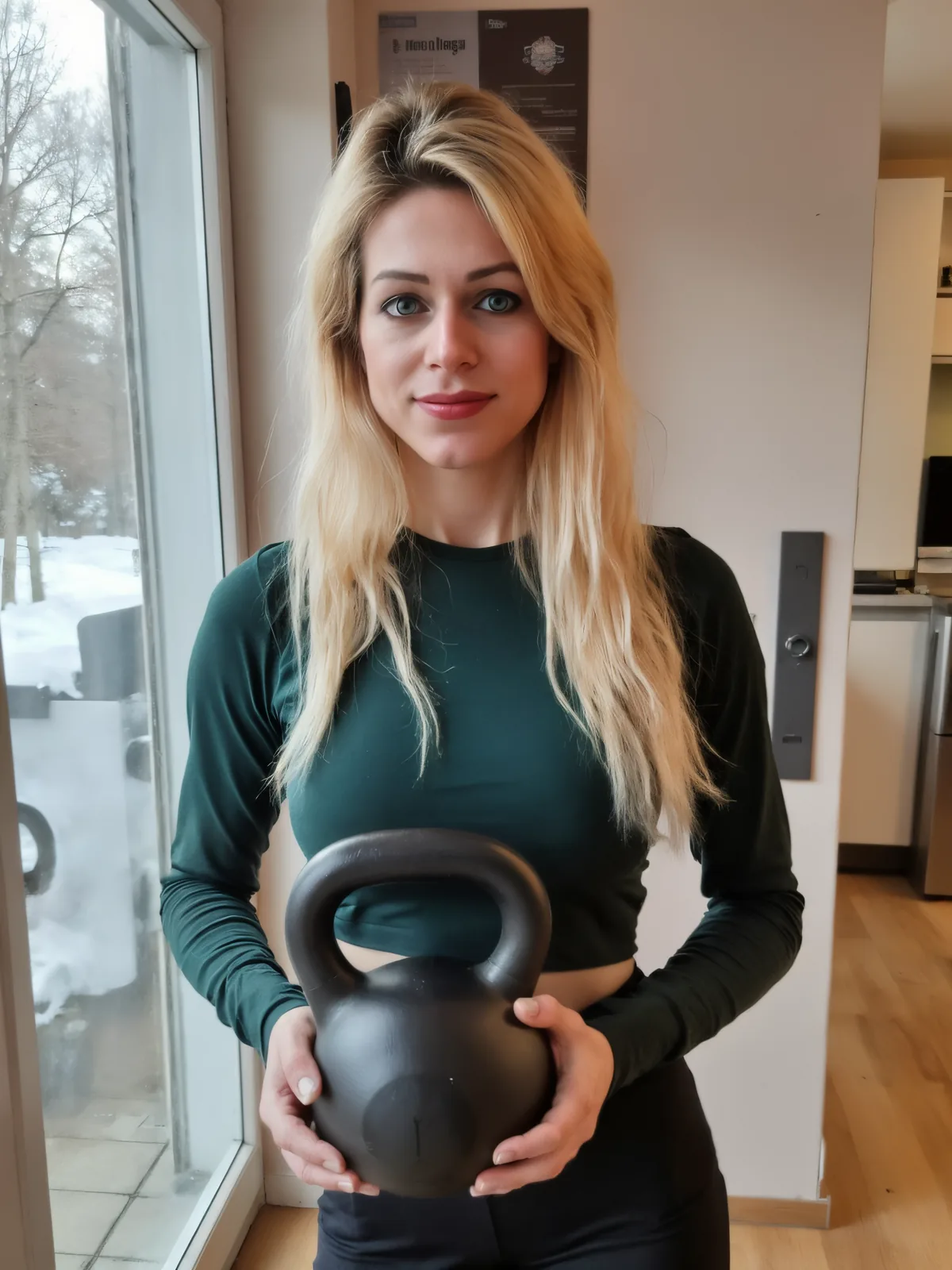
If you have never lifted, forty is the best time you have left to start, and the reason is arithmetic rather than inspiration. From roughly the mid-thirties, muscle that is not asked to work drifts away at something like three to eight percent a decade, faster after the menopause. Lifting is the only thing that reliably turns that around, and the women with the most to gain are the ones who have never done it, because an untrained body answers training fastest. Ten weeks of two or three sessions a week added about 1.4 kg of lean mass, raised resting metabolism by about seven percent and took off about 1.8 kg of fat in the studies reviewed by Westcott. You do not need a gym, a program app or a younger body. You need five movements, a notebook and twelve weeks.
The five movements
Everything a body does is one of these. Learn them with a kettlebell or two dumbbells, and the rest of your training life is variations.
| Movement | Beginner version | Later version | What it builds |
|---|---|---|---|
| Squat | goblet squat to a chair | goblet squat, then barbell | legs, hips, the ability to get up off the floor at eighty |
| Hinge | kettlebell deadlift from a step | Romanian deadlift | hamstrings, glutes, the back that lifts a suitcase |
| Push | incline push-up on a counter | floor push-up, dumbbell press | chest, shoulders, arms |
| Pull | one-arm row with a dumbbell | bent-over row, assisted pull-up | upper back, posture, grip |
| Carry | farmer’s carry, one weight per hand, 30 m | heavier, longer | core, grip, bone, the body that carries shopping without thinking |
How much, in numbers
| Variable | The number | Where it comes from |
|---|---|---|
| Sessions a week | 2 to 3 | the range used across the resistance-training trials reviewed |
| Hard sets per muscle per week | 10 to 20 | the hypertrophy literature; start at 10 |
| Reps per set | 6 to 15 | the range that builds muscle; 8 to 12 is the sweet spot for most women |
| Effort | two reps left in the tank | the last two reps of a set should be slow and ugly but possible |
| Rest between sets | 90 seconds to 2 minutes | long enough that the next set is as good as the last |
| Protein | 1.2 to 1.6 g per kg a day, 25 to 30 g per meal | the Morton meta-analysis plateau and the PROT-AGE position |
| Progression | one more rep or one more kilo than last week | the only rule that matters |
A full-body session of five movements, three sets each, is fifteen hard sets. Three sessions is forty-five sets a week, which is the middle of the range for every muscle you own, in about forty minutes a time.
The progression rule you write on the fridge
Each week, on each movement, do one of two things: add one rep to every set, or add the smallest weight you have. When you reach the top of the rep range (12, say) on every set, add weight and drop back to the bottom (8). That is progressive overload, and it is the whole of the science that matters for the first year.
If a week goes wrong and you miss, repeat the previous week. Do not start again from zero. The body keeps what it built for far longer than you fear.
The twelve weeks
Weeks 1 to 2: learn. Three days, five movements, two sets of 10, a weight you could do 15 with. The point is the pattern, not the effort. Film yourself from the side once; it tells you more than a mirror.
Weeks 3 to 6: build. Three sets of 8 to 12, two reps in reserve. Add reps each week. By week six the goblet squat should be a 12 kg kettlebell or more for most women.
Weeks 7 to 10: load. Three sets of 6 to 10, heavier. The hinge and the squat are now the heaviest things you move all week. This is where bone, not only muscle, starts to answer.
Weeks 11 to 12: test. One set of each movement, as many good reps as you can with the week-six weight. Write the numbers down next to week one. That page is the reason to keep going.
A week that survives real life
| Day | Session | Minutes |
|---|---|---|
| Monday | Full body A: squat, push, row, carry | 40 |
| Tuesday | Walk, 30 minutes, dogs optional | 30 |
| Wednesday | Full body B: hinge, incline push, row, carry | 40 |
| Thursday | Walk or nothing | 0 to 30 |
| Friday | Full body A again, one more rep than Monday | 40 |
| Weekend | One long walk, one proper rest |
The ten-minute version, for the day that falls apart: goblet squat, push-up, row, 3 rounds of 10, no rest. It keeps the habit alive, which is worth more than the session it replaces.
What the research shows
- Westcott, Current Sports Medicine Reports, 2012, narrative review of resistance-training trials in adults including middle-aged and older adults: ten weeks of resistance training increased lean weight by about 1.4 kg, resting metabolic rate by about 7 percent and reduced fat weight by about 1.8 kg, with improvements in bone mineral density in longer studies. The contrary finding: it is a review of mixed studies rather than one trial, and the effects varied with age, program and starting fitness. doi.org/10.1249/JSR.0b013e31825dabb8
- Morton and colleagues, British Journal of Sports Medicine, 2018, meta-analysis of 49 randomised trials with 1,863 participants: adding protein to resistance training increased one-repetition-maximum strength by 2.49 kg and fat-free mass by 0.30 kg beyond training alone, with benefits plateauing beyond about 1.6 g per kg a day. The contrary finding: the effect was smaller in older adults, and the extra strength from protein was modest next to what the training itself produced. doi.org/10.1136/bjsports-2017-097608
Read that second finding the right way round: the training did most of the work. The protein made it stick.
Questions women ask
Will lifting make me bulky? No. With 1.4 kg of lean mass in ten weeks as the realistic high end, the change you will see is shape and posture, not size.
I have a bad back or knees. Can I start? Usually, with the beginner versions and a clinician’s yes if you have a diagnosis. Chair squats, step deadlifts and counter push-ups were built for exactly this.
Cardio or weights? Weights first, walking every day, and the cardio you enjoy on top. Lifting is the one the body cannot replace with anything else.