
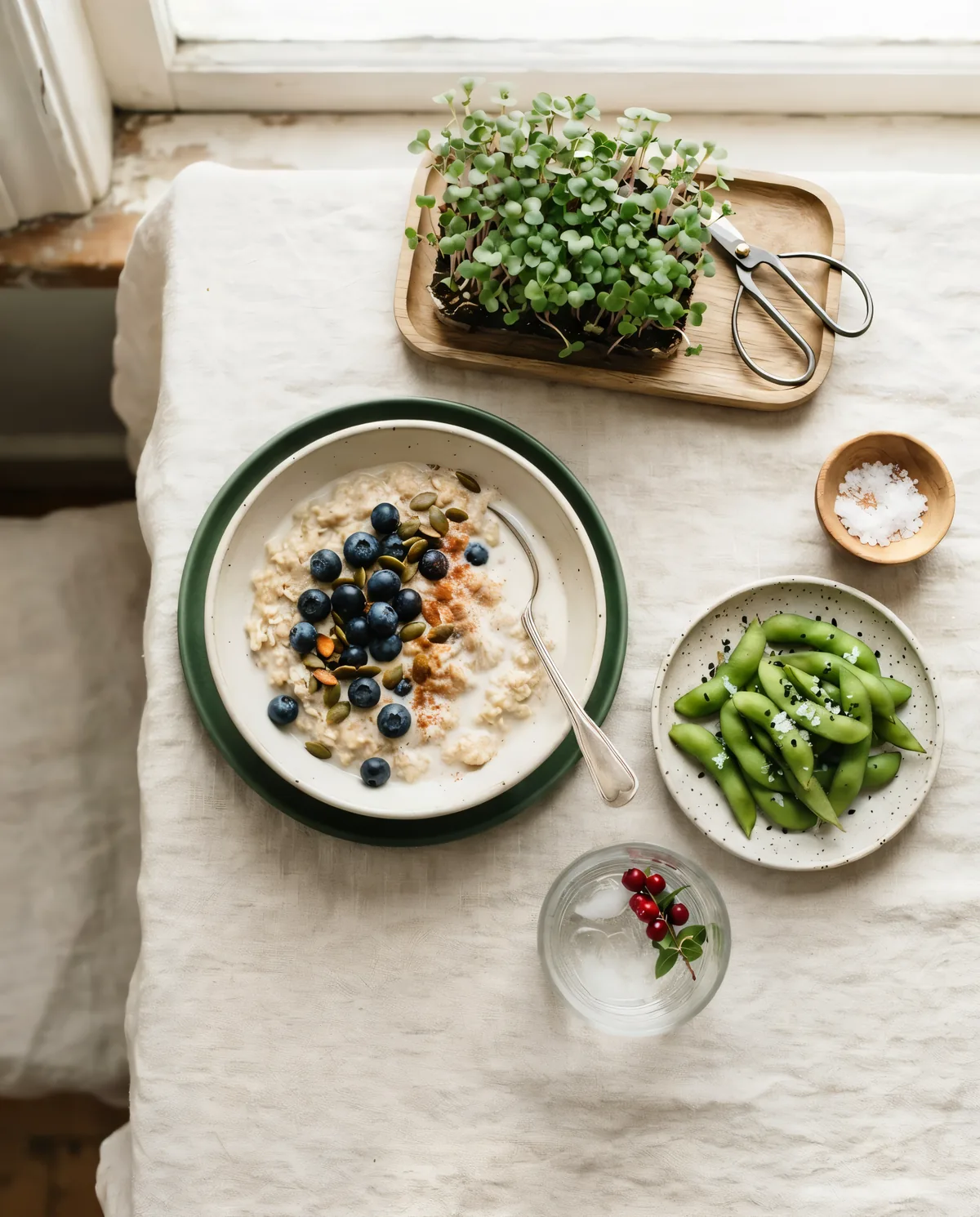
After forty, muscle answers protein less eagerly than it did at twenty-five. Researchers call it anabolic resistance: the same 15 g of protein that switched on muscle building in a younger body no longer clears the threshold. The answer is not a powder-fuelled diet; it is a higher floor per meal and a higher total per day, spread evenly, on foods you already eat. On a plant-based plate that takes a little planning and no compromise: when protein is matched gram for gram, plant and animal diets built the same muscle in the trials that bothered to match them.
The numbers
| Reference | Amount | For a 65 kg woman |
|---|---|---|
| EFSA population reference intake, all adults | 0.83 g per kg a day | 54 g |
| PROT-AGE position, older adults, to keep muscle | 1.0 to 1.2 g per kg a day | 65 to 78 g |
| The training plateau, Morton meta-analysis | about 1.6 g per kg a day | 104 g |
| Per meal, to switch muscle building on | 25 to 30 g, with 2.5 to 3 g leucine | three meals |
| Distribution | even across three meals | about 25 percent more muscle built over a day than the same protein skewed to dinner |
The practical target for a woman over forty who lifts: 1.2 to 1.6 g per kg, in three meals of 25 to 35 g. For most women that is 80 to 100 g a day, and the shortfall, when the log is counted, is nearly always at breakfast and lunch.
Leucine, the switch
Muscle protein synthesis is triggered mostly by one amino acid, leucine, and a meal needs about 2.5 to 3 g of it to clear the threshold after forty. Soy, pea, lentils and seitan carry enough per 25 to 30 g serving of protein; grains and vegetables do not, which is why a bowl of quinoa and broccoli, however large, does not count as a protein meal. Anchor every meal on a legume, a soy food or seitan, and the leucine takes care of itself.
Plant proteins, per portion
| Food | Portion | Protein | Leucine |
|---|---|---|---|
| Seitan | 100 g | 25 g | 1.8 g |
| Soy protein powder | 30 g scoop | 25 g | 2.1 g |
| Pea protein powder | 30 g scoop | 22 to 25 g | 2.0 g |
| Tempeh | 100 g | 19 g | 1.5 g |
| Lentils, cooked | 200 g | 18 g | 1.3 g |
| Black beans, cooked | 200 g | 17 g | 1.4 g |
| Firm tofu | 150 g | 17 g | 1.4 g |
| Edamame, shelled | 1 cup (155 g) | 17 g | 1.4 g |
| Chickpeas, cooked | 200 g | 15 g | 1.1 g |
| Hemp seeds | 30 g | 9 g | 0.6 g |
| Pumpkin seeds | 30 g | 9 g | 0.7 g |
| Oats, dry | 60 g | 8 g | 0.6 g |
| Soy milk | 250 ml | 7 to 8 g | 0.6 g |
| Peanut butter | 30 g | 8 g | 0.6 g |
Three meals that each reach thirty grams
Breakfast, 31 g. Porridge from 60 g of oats on 300 ml of soy milk, 20 g of hemp seeds, a spoon of peanut butter, berries. Five minutes; the oats do the rest.
Lunch, 33 g. A bowl of 200 g lentils with tomatoes and a squeeze of lemon, 100 g of firm tofu seared in the same pan, pea shoots on top. Cook the lentils on Sunday.
Dinner, 34 g. 100 g of tempeh with 150 g of black beans, roasted roots, tahini, a handful of pumpkin seeds. The leftovers are tomorrow’s lunch.
The post-workout version: a shake of 30 g pea protein in soy milk with a banana, 35 g, in the hour after training when the kitchen is not an option.
The rules after forty
Breakfast is the meal to fix first. Most women eat 8 g at breakfast and 50 g at dinner. Moving protein to the morning does more for muscle than adding it at night.
Thirty grams, three times, beats ninety once. The Mamerow crossover trial found about 25 percent more muscle protein synthesis over a day from an even spread than from the same total skewed to dinner.
Lift, or the protein has nowhere to go. Two or three strength sessions a week are the reason the body keeps what it eats.
Powder is a tool, not a confession. A scoop in the oats is the fastest 20 g on a difficult morning.
Count it for three days. A kitchen scale and a free app. The number is almost always 20 to 40 g lower than you think, and the shortfall is in the first half of the day.
What the research says
- Bauer and colleagues, Journal of the American Medical Directors Association, 2013, PROT-AGE expert position paper: older adults need more than the 0.8 g per kg RDA to maintain muscle, with 1.0 to 1.2 g per kg a day and 25 to 30 g per meal suggested to trigger muscle protein synthesis. The contrary finding: an expert consensus rather than a trial, written about people over 65. doi.org/10.1016/j.jamda.2013.05.021
- Morton and colleagues, British Journal of Sports Medicine, 2018, meta-analysis of 49 randomised trials with 1,863 participants: adding protein to resistance training increased one-repetition-maximum strength by 2.49 kg and fat-free mass by 0.30 kg beyond training alone, plateauing beyond about 1.6 g per kg a day. The contrary finding: the effect shrank with age. doi.org/10.1136/bjsports-2017-097608
- Mamerow and colleagues, Journal of Nutrition, 2014, randomised crossover trial in eight adults: 24-hour muscle protein synthesis was about 25 percent higher when 90 g of protein was spread evenly over three meals than when skewed toward dinner. The contrary finding: eight people, one week, animal protein. doi.org/10.3945/jn.113.185280
- Hevia-Larraín and colleagues, Sports Medicine, 2021, randomised trial of 38 young men over twelve weeks: leg lean mass and strength gains did not differ between a high-protein plant-based diet and a protein-matched omnivorous diet. The contrary finding: both groups were fed 1.6 g per kg, so it says nothing about plant diets that fall short of that, and the participants were young men. doi.org/10.1007/s40279-021-01434-9
Questions women ask
Is 1.6 g per kg too much for my kidneys? Not for healthy kidneys; the trials above ran at that level without harm. Kidney disease is a different conversation, with a clinician.
Do I have to combine proteins at every meal? Across the day is enough. A legume and a grain somewhere in the same day covers it.
What about the days I do not train? The same. Muscle is built in the 48 hours after a session, which is most of the week.